
Talent Acceleration & A&R Operations Blueprint
Talent Intelligence, Creative Operations & Release Execution: a 13-slide document I wrote on my own for a WeTalkSound internship application.
- role
- Author (independent)
- format
- 13 landscape slides (PDF)
- created
- October 2026
- prepared for
- A WeTalkSound internship application
- commissioned
- No. Independent work
Project overview
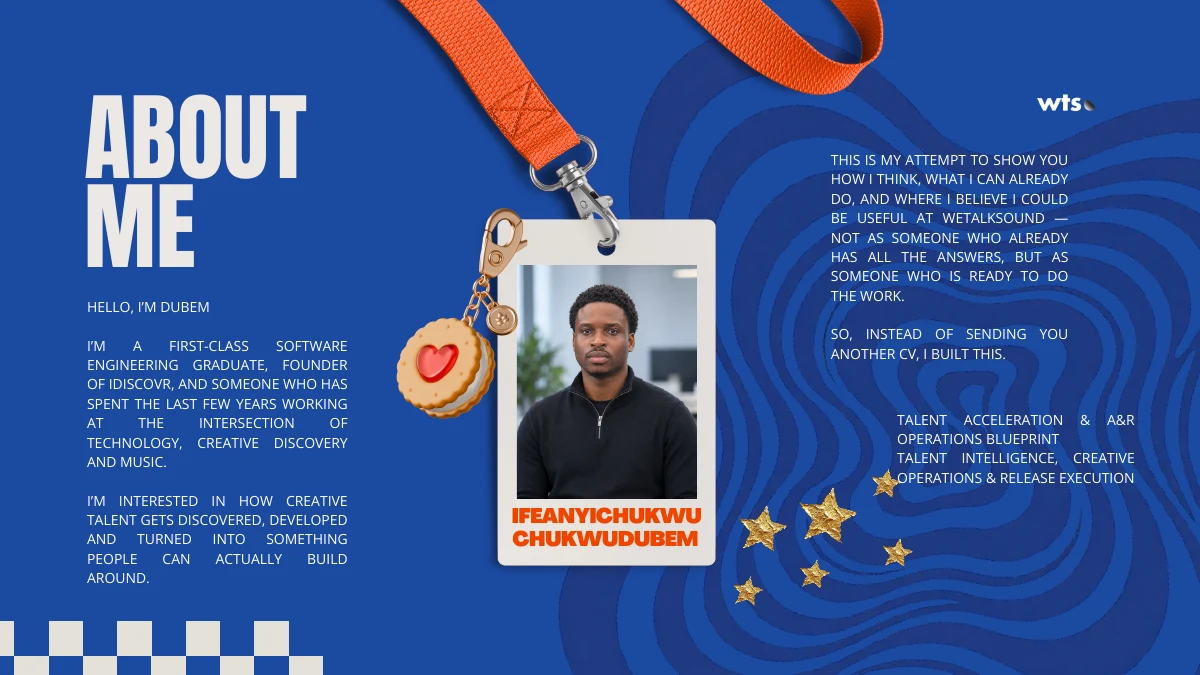
Instead of sending only a CV, I built a working proposal. The document sets out how I think about talent discovery, creative operations and A&R, what I can already do, and where I believe I could be useful at WeTalkSound. It presents me as someone ready to do the work, not as someone who already has every answer.
The full document
The complete document is published here as I wrote it, with three small privacy edits listed below.
Context and motivation
I wrote the blueprint myself as part of my application for an internship at WeTalkSound, a company that works across culture, content, talent and label services. It was independent work, not a commissioned project.
The problem or opportunity it examines
The document starts from a simple observation: a company like WeTalkSound does not need another channel for finding talent. The more interesting opportunity is what happens after a promising artist, producer or creative enters its orbit.
Across recommendations, projects, communities and programmes, useful information about creatives can stay scattered across conversations, links and individual memory. That makes it harder to act when an A&R opportunity, collaboration, development project or release comes up.
The framework and key ideas
The document organises its argument into four connected ideas.
- Talent intelligence. A structured layer for organising information about creatives: their role, their music or portfolio, their creative direction, relevant collaborators, strengths, development gaps and previous interaction with the company. It changes the question from “do we know any artists that…?” to “we know this creative: what do we know about what they can do, and should we do something with that?”
- Creative and producer operations. Keeping a clear view of a recording project, compilation or development programme: who is involved, what has been created, which version is current, what is outstanding and what happens next. As work moves toward label services and distribution, metadata, credits, splits, assets, artwork, scheduling and delivery requirements become part of the same process. The stated goal is to reduce the distance between “this is promising” and “this is ready to move”.
- Structured A&R development insight. An analytical lens for the space between hearing something promising and being able to explain why it is promising, what would make it stronger and what the next development decision should be. The document works through two worked examples, set out below.
- Culture to release. Treating audience response as A&R information once a record is out: which part of the story travelled, what people responded to, which content generated genuine interest, who found the artist through it, and whether the record created new collaboration or community opportunities.
The two worked examples
To show the A&R lens in use, the document works through two examples. They are analytical exercises in the document. They are not presented as formal engagements or credits.
- Imelda IDK. The approach starts by assessing the artist’s existing sound, identity and target audience, then pinpoints the core direction, identifies development gaps and works out the material, collaborations, content and release strategy that could elevate the work.
- Emmytee. A different question: a producer can build creative equity through production credits, collaborators and a recognisable sound while staying relatively invisible as an artist. The document asks whether that producer identity already contains the foundations of a stronger artist proposition, and explores how production credibility, original material and personal story could reinforce one another.
How the document is structured
The document is a 13-slide landscape presentation. It opens with an introduction and positioning, then moves through the four ideas above, and closes with what I bring and a proposition.
- Introduction and positioning (opening slides)
- Talent intelligence: from encounter to opportunity, and organising creative information (three slides)
- Creative and producer operations (two slides)
- Artist A&R: structured development insight, with the two worked examples (two slides)
- Culture to release: connecting music to audience response (one slide)
- What I bring, the proposition, and a closing note (final three slides)
My research and contribution
I wrote the document on my own. It draws on three strands of my background: building iDiscovr and its university-based discovery work, which involved understanding creatives through their capabilities, work and potential connections; informal, uncredited exposure to the operational side of artist and producer workflows; and my work on music commentary, artist spotlights and music-business analysis, which shaped the culture-to-release section. My Software Engineering background shows up as systems thinking and a habit of turning repeated activities into manageable workflows.
The document is explicit about its limits: I am not presenting myself as an experienced A&R executive. I am presenting myself as someone who can help make the thinking around A&R more organised, researched and actionable.
What the document argues
- After discovery, the bottleneck is often information: knowing what you already know about a creative.
- Operational discipline (versions, credits, assets, delivery) is what turns a promising record into one that is ready to move.
- A&R thinking is stronger when it can explain why something is promising and what the next development decision should be.
- Audience response after release is another source of A&R information.